#include <partondistribution.h>
Public Member Functions | |
| partondistribution (void) | |
| partondistribution (int n, double Q0, double A[], double alpha[], double beta[], int eta=1) | |
| partondistribution (int n, double Q0, const std::valarray< double > &A, const std::valarray< double > &alpha, const std::valarray< double > &beta, int eta=1) | |
| double | get_Q0 (void) const |
| int | get_eta (void) const |
| complex_d | get_Mellin_transform (complex_d z) const |
| double | get_F (double x, double z) const |
| double | get_dF (double x, double z) const |
| double | get_ddF (double x, double z) const |
| double | get_dddF (double x, double z) const |
| double | get_c0 (double x) const |
| virtual bool | with_qed (void) const |
| virtual double | get_electric_charge (void) const |
Protected Attributes | |
| int | n |
| double | Q0 |
| std::valarray< double > | A |
| std::valarray< double > | alpha |
| std::valarray< double > | beta |
| int | eta |
Private Member Functions | |
| double | root_safeI (double a, double b, double x) const |
Friends | |
| partondistribution | operator+ (const partondistribution &f1, const partondistribution &f2) |
Detailed Description
The class partondistribution represents the parameterization of a parton distribution in the form
![\[ x f(x,Q_0^2) = \sum\limits_{i=0}^{n-1} A_i x^{\alpha_i} (1-x)^{\beta_i} \]](form_90.png)
In addition this class has a data member  , which selects odd or even moments for the evolution. The default value for
  in the constructor is
  , which is good for the singlet distributions and non-singlet non-valence distributions like
![\[ (u+\bar{u}) - ( d + \bar{d} ), \]](form_9.png)
![\[ (u+\bar{u}) + ( d + \bar{d} ) - 2 ( s + \bar{s} ), ... \]](form_10.png)
Valence non-singlet distributions like
![\[ (u-\bar{u}), (d - \bar{d}), ... \]](form_7.png)
need  , which has to passed explicitly to the constructor.
Constructor & Destructor Documentation
§ partondistribution() [1/3]
| partondistribution | ( | void | ) |
Default constructor
§ partondistribution() [2/3]
| partondistribution | ( | int | nr, |
| double | Q0r, | ||
| double | Ar[], | ||
| double | alphar[], | ||
| double | betar[], | ||
| int | etar = 1 |
||
| ) |
Standard constructor
§ partondistribution() [3/3]
| partondistribution | ( | int | nr, |
| double | Q0r, | ||
| const std::valarray< double > & | Ar, | ||
| const std::valarray< double > & | alphar, | ||
| const std::valarray< double > & | betar, | ||
| int | etar = 1 |
||
| ) |
Standard constructor from valarray
Member Function Documentation
§ get_c0()
| double get_c0 | ( | double | x | ) | const |
Returns for fixed  the position of the minimum in the
  -plane of the function
![\[ F(x,z) = x^{-z} \sum\limits_{i=0}^{n-1} A_i B(z+\alpha_i-1,1+\beta_i). \]](form_77.png)
on the real axis right to the rightmost pole.
§ get_dddF()
| double get_dddF | ( | double | x, |
| double | z | ||
| ) | const |
Evaluates
![\[ \frac{d^3}{dz^3} F(x,z) = \sum\limits_{i=0}^{n-1} \left( G_i''' + 3 G_i'' G_i' + G_i'^3 \right) F_i \]](form_85.png)
where
![\[ G_i''' = \Psi''(z+\alpha_i-1) - \Psi''(z+\alpha_i+\beta_i) \]](form_86.png)
§ get_ddF()
| double get_ddF | ( | double | x, |
| double | z | ||
| ) | const |
Evaluates
![\[ \frac{d^2}{dz^2} F(x,z) = \sum\limits_{i=0}^{n-1} \left( G_i'' + G_i'^2 \right) F_i \]](form_83.png)
where
![\[ G_i'' = \Psi'(z+\alpha_i-1) - \Psi'(z+\alpha_i+\beta_i) \]](form_84.png)
§ get_dF()
| double get_dF | ( | double | x, |
| double | z | ||
| ) | const |
Evaluates
![\[ \frac{d}{dz} F(x,z) = \sum\limits_{i=0}^{n-1} G_i' F_i \]](form_79.png)
where
![\[ F_i = x^{-z} A_i B(z+\alpha_i-1,1+\beta_i), \]](form_80.png)
![\[ G_i = \ln \left( x^{-z} B(z+\alpha_i-1,1+\beta_i) \right) \]](form_81.png)
![\[ G_i' = -\ln x + \Psi(z+\alpha_i-1) - \Psi(z+\alpha_i+\beta_i) \]](form_82.png)
§ get_electric_charge()
|
inlinevirtual |
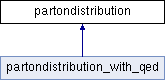
Return zero for a partondistribution. The method is overridden by the derived class partondistribution_with_qed.
Reimplemented in partondistribution_with_qed.
§ get_eta()
| int get_eta | ( | void | ) | const |
Returns .
§ get_F()
| double get_F | ( | double | x, |
| double | z | ||
| ) | const |
Evaluates the function
for the given pair  .
.
§ get_Mellin_transform()
Evaluates the Mellin transform of the parton distribution
![\[ f^z(Q_0^2) = \sum\limits_{i=0}^{n-1} A_i B(z+\alpha_i-1,1+\beta_i) \]](form_75.png)
at the point .
§ get_Q0()
| double get_Q0 | ( | void | ) | const |
Returns  .
.
§ root_safeI()
|
private |
Solves numerically the equation
![\[ \frac{d}{dz} F(x,z) = 0 \]](form_88.png)
for .
§ with_qed()
|
inlinevirtual |
Return false for a partondistribution. The method is overridden by the derived class partondistribution_with_qed.
Reimplemented in partondistribution_with_qed.
Friends And Related Function Documentation
§ operator+
|
friend |
Addition of two parton distributions
The sum of two parton distributions is given by
![\[ \sum\limits_{i=0}^{n-1} A_i x^{\alpha_i} (1-x)^{\beta_i} + \sum\limits_{i=0}^{n'-1} A_i' x^{\alpha_i'} (1-x)^{\beta_i'} \]](form_89.png)
The values of and of the two summands have to agree, otherwise the function throws an exception.
The documentation for this class was generated from the following files: